
Geoff Johns and Green Lantern, Explained
A book selling 36,425 copies an issue grew into one of DC's biggest franchises. This covers what Geoff Johns built, who else deserves credit, and what outlasted him.
Oct 24, 2026 · Phil · 14 min read
The short version
I'd argue most of what you picture when you picture Green Lantern was built by Geoff Johns, or rebuilt by him. From Green Lantern: Rebirth in 2004 to Green Lantern #20 in 2013, he wrote more than 100 issues, co-wrote the Green Lantern Corps relaunch, introduced the emotional spectrum, and ran the Sinestro Corps War and Blackest Night.
And Green Lantern was only part of it. He also wrote The Flash, JSA, Teen Titans, Superman, Justice League, and Aquaman, and he's now building a universe of his own at Ghost Machine.
The sales say the same thing. Green Lantern #180 sold an estimated 36,425 copies in August 2004, and Green Lantern #45 sold an estimated 102,431 in August 2009. Blackest Night #1 finished 2009 as Diamond's #2 comic, behind only Amazing Spider-Man #583, and Blackest Night took 6 of the top 10 spots.
Two popular claims need fine print, and the real story survives both. "Outsold Batman" holds up for specific books in specific months. As a statement about the whole franchise, I can't back it. "Longest run ever" doesn't hold either. What does hold up is the scope: he wrote the flagship, co-wrote the Corps relaunch, and steered the events that pulled the other Lantern titles in.
Timeline at a glance
| When | What happened |
|---|---|
| August 2004 | Green Lantern #180 sells an estimated 36,425 copies. That's the baseline for everything below. |
| December 2004 to May 2005 | Green Lantern: Rebirth. Hal Jordan returns, and the yellow impurity becomes a fear entity. |
| July 2005 | Green Lantern vol. 4 #1 starts Johns' monthly run. |
| November 2005 to March 2006 | Green Lantern Corps: Recharge, co-written by Johns and Dave Gibbons, relaunches the Corps. |
| 2007 to 2008 | The Sinestro Corps War. Green Lantern vol. 4 #10 had already introduced the Sinestro Corps. |
| Late 2007 | The Red Lanterns debut in Green Lantern vol. 4 #25 (cover dated January 2008). |
| 2008 | Secret Origin (Green Lantern #29-35) and Rage of the Red Lanterns. |
| May 2, 2009 | Blackest Night #0 ships on Free Comic Book Day. |
| July 2009 | Blackest Night #1 sells an estimated 177,105 copies. |
| 2010 to 2013 | Brightest Day, War of the Green Lanterns, Rise of the Third Army, Wrath of the First Lantern. |
| May 22, 2013 | Green Lantern #20, a 64-page finale, is Johns' last issue. |
| June 2013 | Robert Venditti takes over with #21. |
| October 2023 | Johns co-founds Ghost Machine, a creator-owned cooperative publishing through Image Comics. |
| August 2026 | HBO's Lanterns premieres. Johns isn't involved. |
Where Green Lantern stood before Johns
By 2004 the Green Lantern monthly was in rough shape. Hal Jordan had been gone for a decade, first as the villain Parallax and then as the Spectre, and the series was cancelled with issue #181 to clear the way for a relaunch. Our Emerald Twilight explainer covers how it got there.
Johns says his first Green Lantern conversations were with DC's Dan DiDio and Peter Tomasi, who both wanted to relaunch the book. The numbers show how much room there was to grow, since #180 had sold an estimated 36,425 copies that August.
Rebirth: the job he was handed
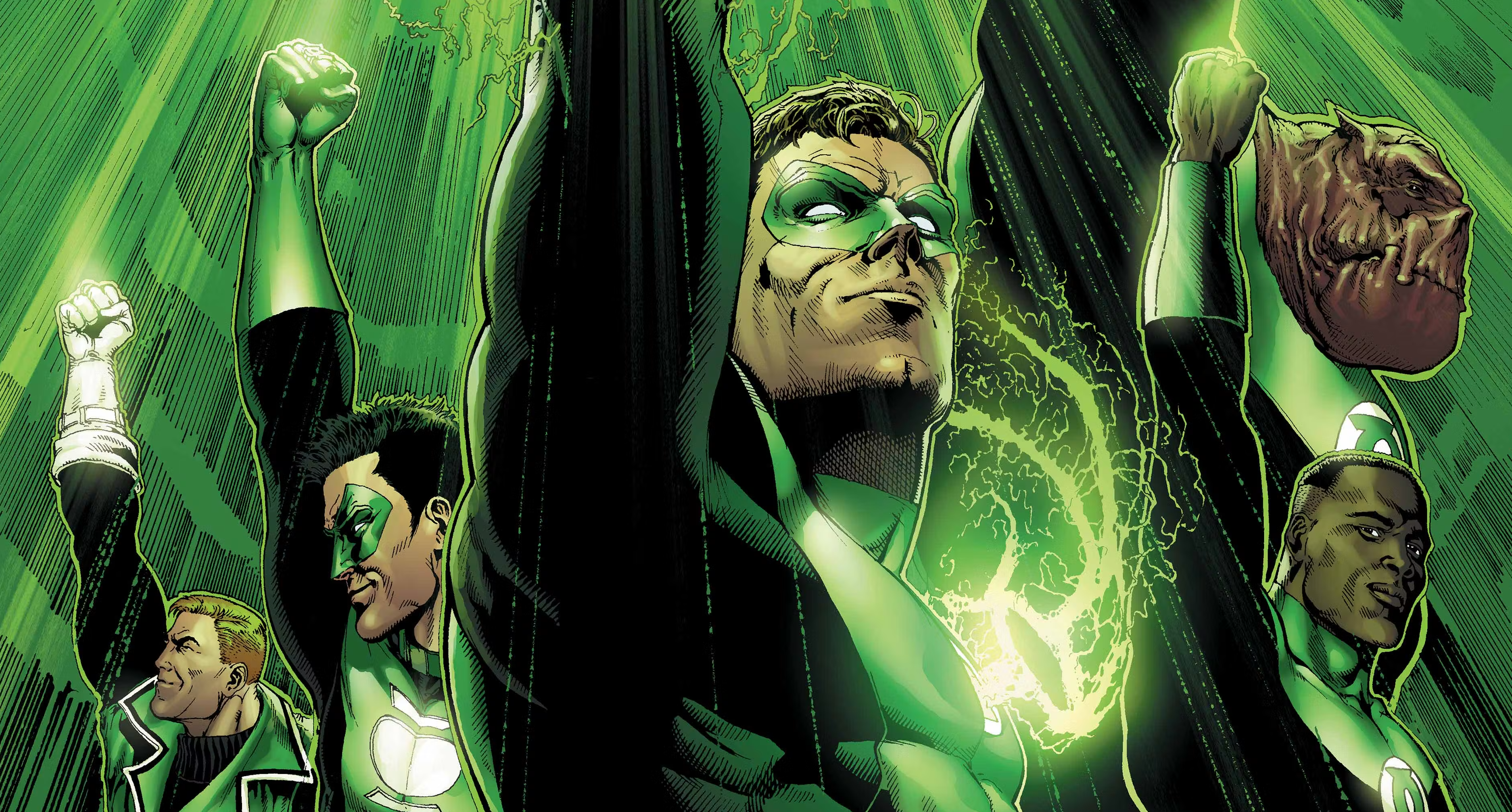
Green Lantern: Rebirth ran 6 issues, cover dated December 2004 through May 2005, with Ethan Van Sciver on art. The first issue went through 4 printings and sold about 157,000 copies.
Rebirth did the heavy lifting for everything after it. It turned Parallax into an ancient fear entity, which also explained the old yellow weakness. Johns has said that making the yellow impurity the power of fear is what led him to an emotional spectrum, with green as the pure center.
That's the seed of the whole run. Every Corps below grows out of that one retcon.
What Johns added to the mythos
Before Johns, the Green Lantern Corps was the only Corps most readers could name. By 2010 there were rings in nearly every color of the spectrum.
- Green Lantern CorpsWillpower
- The original, rebuilt after Rebirth.
- Sinestro CorpsFear
- Debuts in Green Lantern vol. 4 #10. Created by Johns and Van Sciver.
- Red LanternsRage
- Atrocitus debuts in Green Lantern vol. 4 #25 (cover dated January 2008). Created by Johns and Van Sciver.
- Orange LanternAvarice
- Larfleeze, the lone Orange Lantern, arrives in Agent Orange.
- Blue LanternsHope
- Saint Walker is the face of it.
- Star SapphiresLove
- Not a Johns creation. John Broome turned Carol Ferris into Star Sapphire in Green Lantern #16. Johns made them a Corps.
- Indigo TribeCompassion
- Created by Johns and Van Sciver.
- Black LanternsDeath
- The army of Blackest Night.
- White LanternLife
- The light that combines the others.
Each of these worked as a story engine. The Sinestro Corps War gave the yellow light an army. Rage of the Red Lanterns put Sinestro in the hands of Atrocitus. Blackest Night put every color in one fight.
Secret Origin (Green Lantern #29-35, with Ivan Reis) retold Hal's beginnings so the new pieces had roots. Sinestro is Hal's mentor in it, and the Blackest Night prophecy is already buried in the story. Johns also turned Sinestro from Hal's greatest enemy into a tragic figure with his own Corps, which I'd call a bigger swing than any new color.
Blackest Night is the payoff. It was an 8-issue miniseries with a #0 on Free Comic Book Day, plus tie-ins across the DC line. Johns and Van Sciver have both described it as the third part of a trilogy that began with Rebirth and continued through the Sinestro Corps War.
The name first appeared as a prophecy at the end of the Sinestro Corps War, about a year and a half before the event shipped. In December 2007, Johns said he had the monthly plotted through issue #55.
Green Lantern Corps: Recharge and the wider family
Johns didn't stop at Hal. He co-wrote Green Lantern Corps: Recharge with Dave Gibbons, a 5-issue miniseries with Patrick Gleason on pencils, cover dated November 2005 to March 2006. It was one of the two direct follow-ups to Rebirth, alongside the new Green Lantern monthly.
Recharge put the Corps back on the map. It introduced Soranik Natu, Vath Sarn, and Isamot Kol, who kept turning up in later Lantern stories, and it led to the Green Lantern Corps monthly in June 2006, the first monthly Corps series since 1988.
Other writers handled that monthly, and Johns' events ran straight through the whole family of books. War of the Green Lanterns crossed Green Lantern with Green Lantern Corps and Emerald Warriors, and Peter J. Tomasi, who wrote Emerald Warriors, also co-wrote Brightest Day with him.
How long was the run, really?
Rebirth started in December 2004, and Green Lantern #20 hit stands on May 22, 2013. That's about 8 and a half years of publication. The "nine years" and "nearly ten years" you'll see quoted count from Johns' first proposals, before Rebirth shipped.
DC and Johns both counted over 100 issues, which includes Rebirth, the Blackest Night series, and specials. That's a big number for a modern superhero book.
So was it unprecedented? On the calendar, no. John Broome was the primary writer on Hal's Silver Age book from 1959 until he left comics around 1970.
What Johns had was 1 writer, 1 planned story, and a whole line of books built around it. When he left in May 2013, the writers on all 4 Lantern titles left with him.
He did it while serving as DC Entertainment's Chief Creative Officer. When he stepped away, he said he wanted to put his energy into the Justice League side of the DC Universe.
I'd call it the defining run, and that counts for more than the longest one.
Green Lantern vs. Batman: what the sales say
The claim fans repeat is that Green Lantern outsold Batman at its peak. It's a fair claim with fine print. The cleanest comparison is August 2009, when Blackest Night was in its second month and Batman had just come out of its own relaunch.
| Compared | Title | Estimated copies |
|---|---|---|
| Rank 1 | Blackest Night #2 | 146,092 |
| Rank 3 | Batman and Robin #3 | 110,594 |
| Rank 4 | Green Lantern #45 | 102,431 |
| Rank 12 | Green Lantern Corps #39 | 84,241 |
| Rank 13 | Batman #689 | 78,392 |
| Rank 28 | Detective Comics #856 | 58,859 |
Both Green Lantern titles outsold Batman and Detective Comics that month. Batman and Robin, the flagship of the relaunched Batman line, beat both of them.
The top end was closer than you might expect. ICv2 estimated Blackest Night #1 at 177,105 copies in July 2009 and Batman and Robin #1 at 168,604 in June. With reorders, they finished within about 250 copies of each other (185,070 vs 184,826).
The long game favors Green Lantern. Between August 2004 and August 2009, the numbers show Green Lantern up 181.2% and Batman up 8.5%.
Nerdist's ranking of the best Green Lantern runs says Johns made it DC's second-biggest franchise after Batman for a brief time, which is where I'd land.
Who else deserves credit
Ivan Reis drew Secret Origin and Blackest Night. Van Sciver drew Rebirth and co-created the Sinestro Corps and the Red Lanterns. Doug Mahnke drew the monthly book for years.
Gleason penciled Recharge, and he and Peter J. Tomasi went on to carry Green Lantern Corps, which sold 83.0% more copies in August 2009 than it had a year earlier. Tomasi and DiDio also helped start the relaunch conversation.
And the Silver Age did a lot of the groundwork. Broome and Gil Kane gave Johns the Corps, Sinestro, and the Star Sapphires to work with.
Beyond Green Lantern: the rest of the DC shelf
Green Lantern was the peak, but it wasn't the whole career. Johns was one of the most prolific writers DC had for more than a decade, and he left a mark on nearly every major hero in the line.
| Compared | When | What he did |
|---|---|---|
| JSA | 2000, then 2007 to 2009 | Started co-writing with James Robinson, then relaunched the book with Dale Eaglesham. |
| The Flash | From issue #164, 2000 | Became the regular writer. Flash: Rebirth (2009 to 2010, with Van Sciver) brought Barry Allen back. |
| Teen Titans | 2003 | Helped relaunch the team with Mike McKone. |
| Infinite Crisis and 52 | 2005 to 2007 | Wrote the 7-issue Infinite Crisis, then co-wrote 52 with Mark Waid, Grant Morrison, and Greg Rucka. |
| Superman and Action Comics | 2006 to 2011 | "Up, Up and Away!" with Kurt Busiek, "Last Son" with Richard Donner, then Brainiac and Superman: Secret Origin with Gary Frank. |
| Flashpoint | 2011 | The 5-issue event that led into the New 52. |
| Justice League and Aquaman | 2011 | Wrote Justice League with Jim Lee and relaunched Aquaman. |
| Doomsday Clock | 2018 to 2020 | Twelve issues with Gary Frank, pairing Superman with Doctor Manhattan. |
| Shazam! and Justice Society of America | 2019 to 2020, 2023 to 2024 | Later returns to DC's legacy characters. |
He also ran the company side. Johns became DC Entertainment's Chief Creative Officer in February 2010 and its President and Chief Creative Officer in 2016, and he co-founded DC Films that same year. He stepped down in June 2018 to focus on writing and producing.
That reach carried onto the screen. He co-developed The Flash, Titans, and Doom Patrol for TV, and he shared story credit on Aquaman, which became DC's highest-grossing film at over $1.15 billion. Not many comics writers can say their ideas shaped the books, the movies, and the shows.
What he left behind
Green Lantern #20 closed out Wrath of the First Lantern with a final battle against the First Lantern and the Guardians. Robert Venditti took over with #21.
Venditti said he'd build on Johns' continuity while taking things in his own direction. His first major arc did that by having the emotional spectrum itself drain the universe, which made the Corps look like a danger rather than police. He went on to write 85 issues across the New 52 book and Hal Jordan and the Green Lantern Corps.
I'd argue that's the best evidence of how much Johns built. His successor's first move was to put the spectrum on trial.
The rainbow stuck around anyway. In August 2026, Johns told Rob Liefeld he likes seeing other writers use Saint Walker and Atrocitus, and praised Jeremy Adams' current run and Morgan Hampton's Green Lantern Corps. He hopes the characters he introduced are what lasts.
Even the version of Green Lantern built to break from the spectrum is answering it. Our Absolute Green Lantern explainer covers how Al Ewing swaps feelings for stages of cosmic awareness.
On screen, HBO's Lanterns premiered August 16, 2026, with Hal Jordan and John Stewart. Johns isn't involved, and he told Liefeld he loves it. A Ringer recap ties the show's thin funeral for Hal to Blackest Night #0, where Hal tells the Flash how his own funeral went.
Johns was also set to produce the HBO Max Green Lantern series with Greg Berlanti before it was scrapped in October 2022. And Secret Origin is back in print in a 2026 edition dated October 20.
What he's working on now: Ghost Machine
Johns' current home is Ghost Machine, a cooperative media company announced at New York Comic Con on October 12, 2023. He co-founded it with Brad Meltzer, Jason Fabok, Gary Frank, Bryan Hitch, Francis Manapul, Peter J. Tomasi, and others.
The creators share ownership of their characters and the profits, and the books are published through Image Comics. Hitch summed up the pitch as "Heroes yes. Capes no."
Johns co-created The Unnamed universe, which includes Geiger, his creator-owned series with Gary Frank. He also co-created Rook with Fabok and Brad Anderson, and he writes Hyde Street with Ivan Reis. Geiger: Ground Zero, which he co-wrote with Frank, won a 2024 Ringo Award.
Ghost Machine's Geiger and Redcoat crossover, Radioactive Revolution, was scheduled to start with Geiger #25 on September 9, 2026, with its own #1 due in January 2027. Johns was at Ghost Machine's San Diego Comic-Con booth in July 2026 alongside Fabok. It's a long way from Hal Jordan, and it's the same instinct: build a universe and trust readers to follow it.
Quick answers
- Did Johns invent the emotional spectrum? He introduced it in Rebirth and built the Corps system on top of it. Some pieces were older. Broome turned Carol Ferris into Star Sapphire in Green Lantern #16, and the yellow weakness goes back to the Silver Age.
- Was Blackest Night 2009's best-selling comic? Close. Diamond ranked Blackest Night #1 second for the year, behind Amazing Spider-Man #583, and Blackest Night held 6 of the top 10 spots.
- Did Johns write Green Lantern Corps? He co-wrote its 2005 relaunch, Recharge, with Dave Gibbons. Other writers, including Tomasi, handled the ongoing monthly, and Johns' events ran through it.
- Is Johns involved with Lanterns? No. He's said he loves it.
- Is Johns still writing Green Lantern? Not that I could find. In August 2026 he was talking up the current writers and a new Chapel one-shot with Liefeld.
Where to read it
The 2004-2005 miniseries that starts everything.
Green Lantern Corps: Recharge
The 2005-2006 miniseries Johns co-wrote with Dave Gibbons to relaunch the Corps.
The yellow Corps arrives.
Green Lantern: Secret Origin
Collects Green Lantern #29-35.
Rage of the Red Lanterns and Agent Orange
The other colors show up.
Read the main miniseries and the Green Lantern tie-ins, which together make the full story.
Brightest Day, War of the Green Lanterns, Rise of the Third Army, and Wrath of the First Lantern
The endgame.
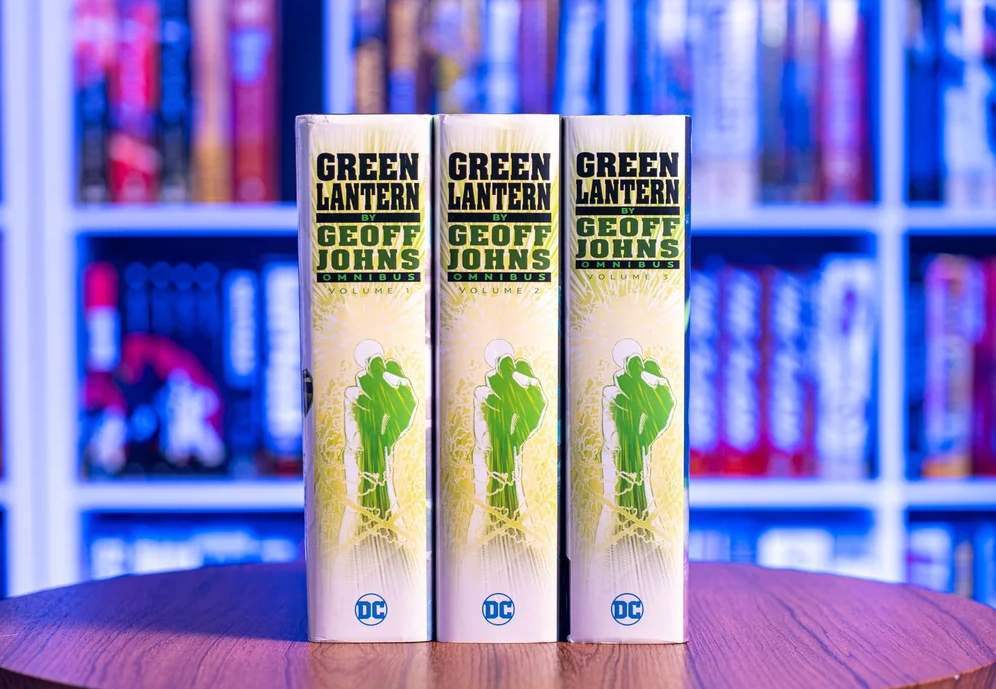
The Green Lantern by Geoff Johns omnibus line collects the run, and Vol. 2 runs from Secret Origin through Blackest Night.
Sales note: all sales figures here are ICv2 estimates compiled by The Beat from Diamond direct market data.
Conclusion
Johns started with a Green Lantern book that DC was relaunching from scratch and left a spectrum of Corps, a 3-part event trilogy, and a line of books that all moved when he did. Then he brought the same ambition to the Flash, Superman, the Justice League, and Aquaman, and he's building something new at Ghost Machine.
Credit is shared. Artists, editors, and Broome's Silver Age foundations made it possible. But I can't name another writer whose run people still read as the default, and when HBO put Hal on screen in 2026, a recap reached for Blackest Night #0 to explain a scene.
The verdictJohns wrote the Green Lantern most readers still measure everything else against, and he's still building.