
Alex DeWitt, Fridging, and the Refrigerator That Changed Comics
In 1994, Green Lantern #54 killed Kyle Rayner's girlfriend Alex DeWitt and left her in his refrigerator. Five years later, Gail Simone used the scene to name a pattern, and the word she coined, fridging, has outlived the website it started on.
Oct 26, 2026 · Phil · 13 min read
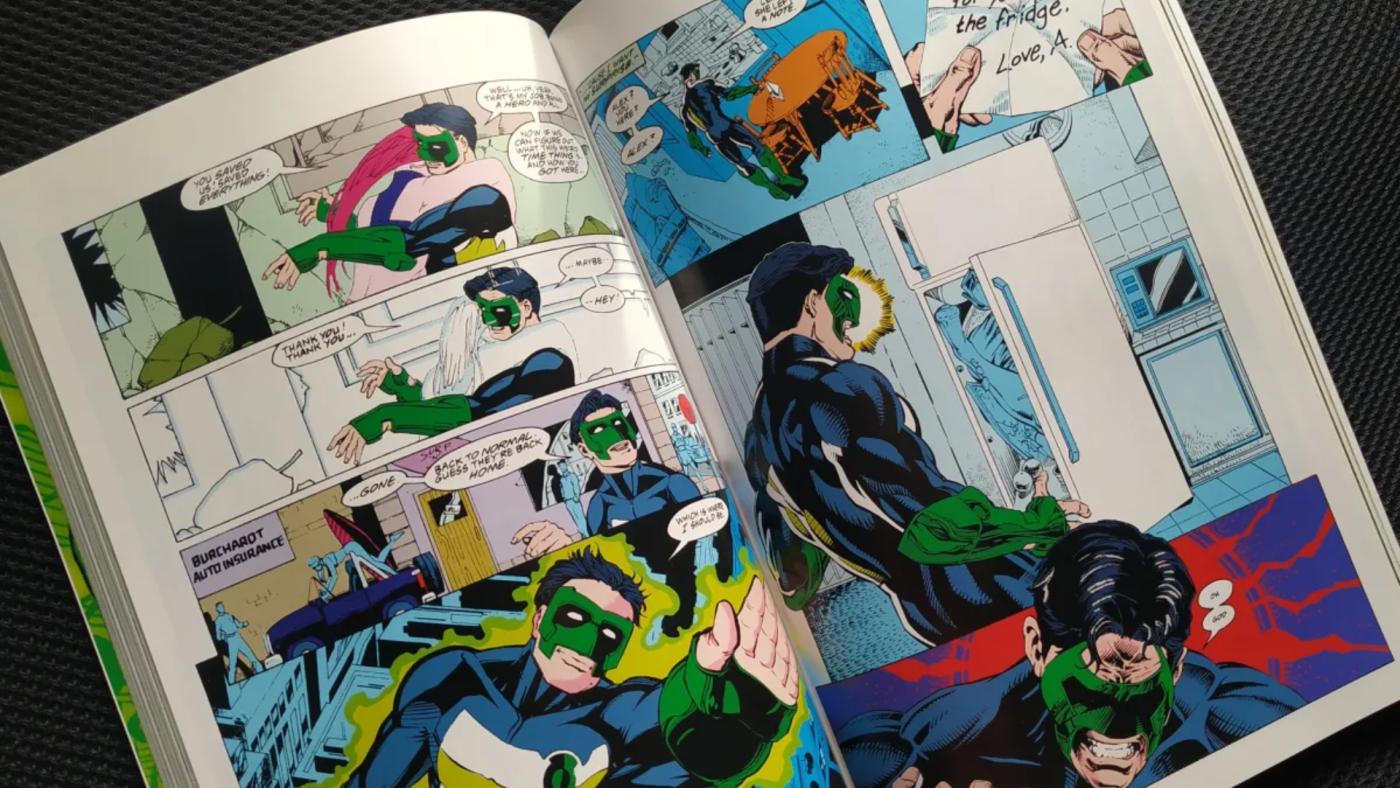
Why the refrigerator matters
A refrigerator might be the most famous piece of furniture in superhero comics, and it earned that status because of what was inside it.
In 1994, Green Lantern #54 included a scene where Kyle Rayner comes home to find his girlfriend, Alex DeWitt, dead and stuffed into his fridge by the villain Major Force. Five years later, a fan named Gail Simone used that scene to name a pattern: female characters being killed, maimed, or depowered to give a male hero something to be sad about. She went on to become a working comics writer, and the word she coined, "fridging," has outlived the website it started on.
I'd argue the scene matters more to comics history than it does as a story. This explainer covers what happened to Alex, how a list on a fan site turned into an industry-wide conversation, and what did and didn't change afterward, both for Green Lantern and for comics as a whole.
Who Alex DeWitt was
Alex DeWitt got six issues. She made a cameo at the end of Green Lantern #48 (January 1994), the issue that introduced Kyle Rayner, and she was dead by #54.
The context matters. Kyle was DC's replacement for Hal Jordan after "Emerald Twilight," the storyline where Hal went on a killing spree, the Green Lantern Corps was destroyed, and Kyle became the last Lantern by pure chance. Marz got the book after DC scrapped Gerard Jones' already-solicited plot for #48, so the run started on short notice and with fans angry about Hal.
Alex was a Los Angeles photojournalist. According to the DC Database fan wiki, she was Kyle's ex, and she had ended things because she found him immature. When he showed up with a power ring she was wary, then became his first ally: she pushed him to be more responsible, helped him design his own costume, and helped him train.
That detail matters for what comes next. Alex had a job, opinions, and real work to do in Kyle's early issues. Marz built her to be liked, and he says so himself.
What happened in Green Lantern #54
"Forced Entry" is a 22-page story scripted by Marz, cover-dated August 1994, with pencils by Steve Carr, Darryl Banks and Derec Aucoin and inks by Romeo Tanghal.
The setup is simple. Kyle gets pulled away to save a future Los Angeles from an earthquake, and while he's gone, Major Force goes looking for Alex. She had promised Kyle a surprise for when he got home. He finds a note pointing him to the fridge, and her body inside it.
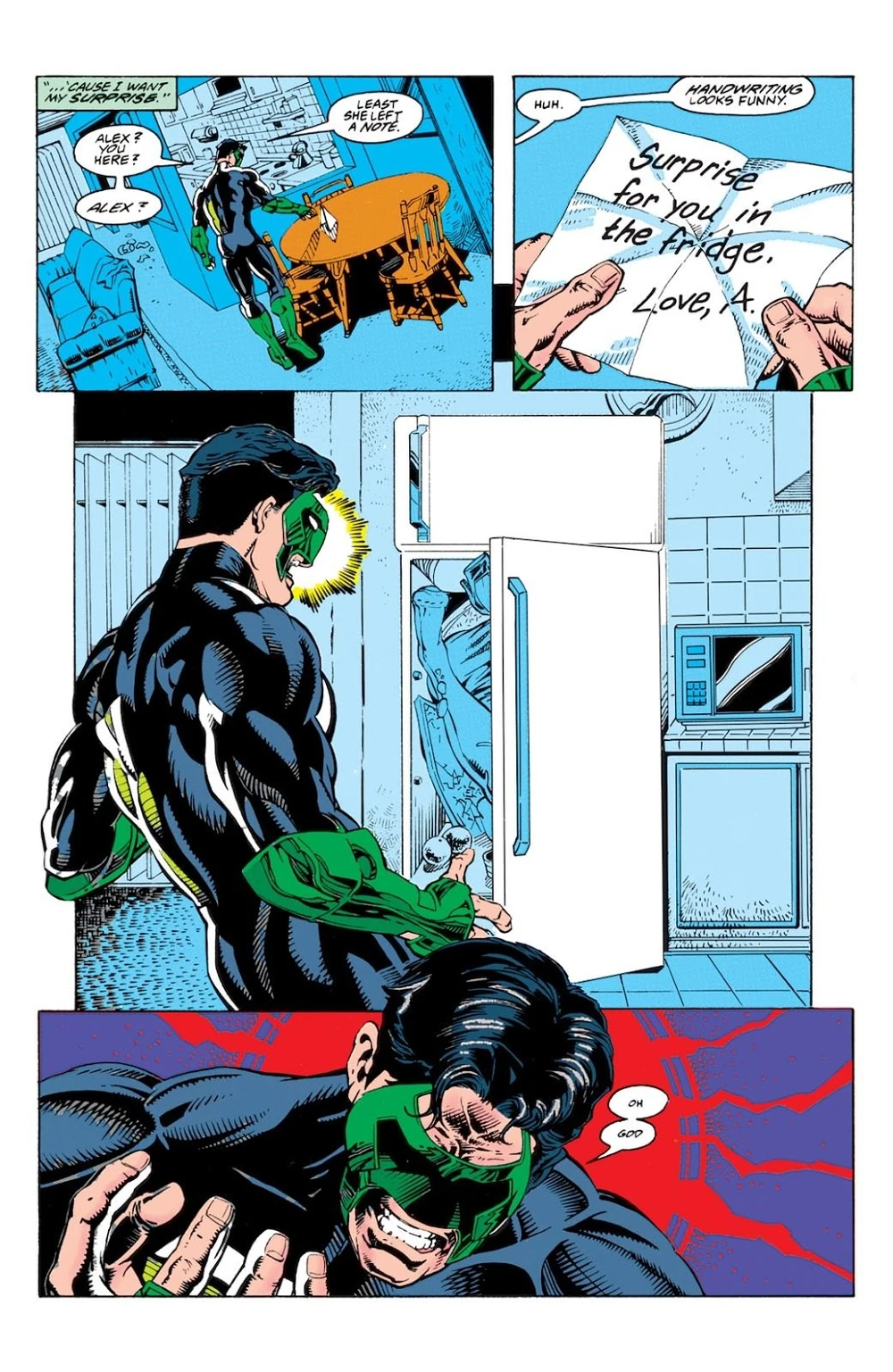
Major Force then walks in, takes credit for the murder, and Kyle's ring runs out of charge at the worst possible moment.
The part everybody remembers wrong is the body. The popular version says Alex was dismembered. Marz says the page as originally written and drawn showed her whole body in one piece, and that the Comics Code objected, so the art was changed to leave the door mostly shut. Readers filled in the blank with something worse.
Banks, the artist, said much the same in a 2020 Newsarama interview, and the blog Crisis on Earth-Prime posted the original and published panels side by side. Banks also argued the term "fridging" only exists because of that censorship. I'd argue the pattern was the story and Alex supplied the image. Any sufficiently memorable death would have done that job.
Gail Simone and the Women in Refrigerators list
In March 1999, Gail Simone and some fellow fans put a list online. It named more than 100 women in superhero comics who had been killed, assaulted, or stripped of their powers, and the site took its name from Alex's refrigerator. Beau Yarbrough designed it, Rob Harris maintained it, and John Bartol was the content editor.
The argument was about readers. Simone's shorthand for it: "If you demolish most of the characters girls like, then girls won't read comics." She framed the list as a look at a pattern across many stories, with no interest in blaming individual creators.
The site also made a case about outcomes. Male heroes tend to die nobly or come back, while the tragedies that hit women tend to stick.
Bartol's essay "Dead Men Defrosting" made that point directly, and Harris used the same pairing: Barry Allen and Supergirl both died in Crisis on Infinite Earths. Barry stayed remembered and revered while Wally West took over the mantle. Supergirl was wiped from continuity within months, and DC did not restore her until 2006.
The list spread through Usenet, bulletin boards and email, and by 2000 several national newspapers had written about it.
How the creators responded
Simone posted the email replies she got, and plenty of professionals answered, including Mark Millar, Geoff Johns and Marz himself. The Dallas Observer reported in 2000 that the responses ran from apologetic to defiant. Steve Englehart told her most comics readers are adolescent boys who fear strong women, and Marv Wolfman said writers kill female heroes more easily because so few of them headline their own books.
Marz's reply deserves a real read, because I think it's smarter than its reputation. He agreed female characters generally have a rougher time, then argued the real dividing line was main characters versus supporting characters. Male-led books were the ones that sold, so title characters stayed protected, and the supporting cast (a lot of it female) took the permanent, shattering changes. His examples were Gwen Stacy and Nova from his own Silver Surfer run.
On Alex, he said she was written to die from her first appearance. He built her carefully so readers would like her, wanted them horrified and feeling Kyle's loss, and wanted the death to sever Kyle's ties to his old life and set up his move to New York. It was also meant to show how vicious Major Force was. "Thus the fridge."
He added that Major Force was punished for it, and that writing a villain doing something despicable is different from endorsing it. He closed by saying comics should be more sensitive to women, and that an industry fighting to survive should stop ignoring half the population as potential readers.
I'd argue that reply makes Simone's case for her. If the supporting cast is where you spend tragedy, and the supporting cast skews female, the pattern is the point. Marz said as much in 1999.
In that 2020 Newsarama interview, as quoted by Crisis on Earth-Prime, Marz said he was just writing a story at the time and not thinking about the larger context. Now, he said, it's impossible to think of it without that context, and he considers that a good thing.
Fallout for Green Lantern
Kyle's story absorbed it. The guilt pushed him to take the job seriously, and he moved from Los Angeles to New York because the city reminded him of Alex. That is the effect Marz says he designed. Jade, another of Kyle's loves, would also die later.
Alex kept coming back, usually as grief or temptation:
- Neron's offer. The demon Neron offered to resurrect her in exchange for Kyle's soul.
- Circle of Fire. A version of Alex appeared as a Green Lantern from another reality. She was later revealed to be a sentient construct of Kyle's ring, representing his capacity for love.
- A Green Lantern Annual. Hal and Kyle swapped lives and Hal stopped Major Force from killing Alex in the past. When they returned to the present, she was dead again.
- Blackest Night (2009). She came back as a Black Lantern. She was shown inside a refrigerator construct, and she trapped Kyle in one too and forced him to relive her death.
Bleeding Cool's headline for the news that she'd return from the same fridge was "Women Out Of Refrigerators." Whether Blackest Night was a wink or a fix depends on who you ask. I lean toward wink.
DC has kept the story in print, reprinting "Forced Entry" in Green Lantern: Kyle Rayner #1 (2017) and the Kyle Rayner Rising compendium (2023). In 2020, James Tynion IV had an evil Rainbow Batman use Alex's death to needle Kyle in Dark Nights: Death Metal Multiverse's End.
What it did to the industry
The list gave comics fans a word, and the word outlived the website. Some universities now point to it in pop culture courses, and the verb "to fridge" has spread to film, TV and games.
Some of the fixes came from inside the books. Stephanie Brown, tortured by Black Mask in 2004's War Games, was later revealed to have survived and got her own Batgirl series in 2009. Barbara Gordon, paralyzed in 1988's The Killing Joke, walked again in 2011 when Simone herself wrote the relaunched Batgirl. Even that got argued over: Simone acknowledged that some fans preferred Barbara as Oracle in the chair.

The pattern kept showing up anyway. Identity Crisis (2004) opened with Sue Dibny's murder and revealed she had been raped by Doctor Light, and it became a flashpoint in the debate over women in comics. War Games ran the same year, and writer Dylan Horrocks has said the team was told from the start that Stephanie would die. Five years after the list, DC ran two major stories built around women's suffering.
Film and TV picked up the vocabulary too. Deadpool 2 originally killed Vanessa, and after negative reactions at test screenings the film added a post-credits scene that reverses it. That is the clearest evidence I know of that the conversation reached the people making these decisions.
The culture around it kept growing. Catherynne M. Valente's novel The Refrigerator Monologues gave the fridged women their own voices and reimagined Alex as Samantha Dean. Amazon was reported to be developing a TV adaptation, Deadtown, in 2018. And Merriam-Webster's slang section now lists "fridge" as a verb and credits Simone for it.
A quick timeline for reference:
| When | What happened |
|---|---|
| 2025 | Merriam-Webster lists "fridge" as a slang verb, credited to Simone. The word has outgrown comics. |
| 2020 | Death Metal Multiverse's End references Alex's death. DC treats the fridge as shared lore. |
| Dec 2018 | Amazon reported developing Deadtown, a TV take on Valente's novel. |
| 2017 | The Refrigerator Monologues is published. The trope gets its own satire. |
| 2014 | Gwen Stacy dies in The Amazing Spider-Man 2. It prompts Valente to write the novel. |
| 2011 | Barbara Gordon walks again in Simone's Batgirl. A 1988 injury is undone. |
| 2009 | Blackest Night returns Alex, and Stephanie Brown gets Batgirl. One callback, one fix. |
| 2004 | Identity Crisis and War Games. The pattern repeats on DC's biggest stages. |
| 2000 | National newspapers cover the site. The argument leaves fandom. |
| Mar 1999 | Women in Refrigerators goes online. The list gets a home. |
| 1994 | Green Lantern #48 (Jan) debuts Alex, and #54 (cover-dated Aug) kills her. The refrigerator. |
| 1988 | The Killing Joke paralyzes Barbara Gordon. A pre-list entry. |
| 1985 | Supergirl dies in Crisis on Infinite Earths. She is erased from continuity until 2006. |
| 1973 | Gwen Stacy dies in Amazing Spider-Man #121. An earlier landmark. |
Where the term gets stretched
The "men die too" objection deserves a fair hearing, and Marz's own list (Captain Mar-Vell, Jason Todd, Bucky, Barry Allen and various former Lanterns) supports it on paper. Simone's team answered that men's deaths tend to reverse and women's tend to stick. Jason Todd, Bucky and Barry Allen all came back in the 2000s, which fits that answer.
The term has also drifted since 1999. Simone's original list covered depowerings and assaults as well as deaths, because her concern was what happens to the characters readers identify with. Today it gets applied to men, to characters of color and to LGBT characters. Vulture's Brian Tallerico, for example, called the death of Lemar Hoskins in The Falcon and the Winter Soldier a racial fridging.
The list itself was loose. TV Tropes points out it mixes strict fridging with heroic deaths of major characters, so a woman dying and a woman being fridged are two different things.
The test most critics use is whether her suffering exists mainly to move a man's story. Alex passes that test by her creator's own description. Whether a character was well-drawn beforehand can be argued either way, which is why The Take calls the trope more useful as a conversation starter than as a verdict on any single story.
Gwen Stacy died in 1973, Supergirl in 1985, and Barbara Gordon was shot in 1988. Alex was the 1994 entry in a long line, and the refrigerator is what made her the one with a name.
Conclusion
By his own account, Marz got the reaction he wanted. People felt Kyle's loss, and we are still talking about it 32 years later.
The cost was a pattern with a name. Simone's list gave fans, critics and eventually writers a way to ask why the same thing kept happening to the same kinds of characters. DC's books have been answering ever since, sometimes with fixes (Barbara walking, Stephanie surviving), sometimes with a wink (Blackest Night), and sometimes by doing it again (Identity Crisis).
Green Lantern fans have a particular stake. Kyle is a Lantern because of "Emerald Twilight," and Alex is the reason his first year hurt. Both things can be true: she was a carefully built character by Marz's account, and her death is the textbook case of the pattern Simone named.
The short versionAlex got six issues of story and a refrigerator, and the refrigerator is the part that changed comics.
Sources
lby3.com, the original Women in Refrigerators site.
Wikipedia.
Alexandra DeWitt and Kyle Rayner
Wikipedia.
DC Database.
DC Universe Guide.
ComicBooks.com.
Green Lantern's Original Fridging Art
Crisis on Earth-Prime, quoting the 2020 Newsarama interview.
Dallas Observer, 2000, syndicated.
Women Write About Comics: Round One
Women Write About Comics.
Wikipedia.
Five More Newsbites From Emerald City Comic Con
Bleeding Cool.
Merriam-Webster slang.
Women in Refrigerators and The Women in Refrigerators Trope, Explained
TV Tropes and The Take.